Crypto vs Fiat Casinos: How Payments Differ for Players
Crypto and fiat casinos handle deposits, withdrawals, fees and protection in different ways. Here is what really changes for a player, and what does not.
By CasinoRadius team, updated 30 October 2026, 6 min read
Last checked: 29 October 2026
Online casinos accept two broad kinds of money. Fiat means normal currency moved by card, bank transfer or e-wallet. Crypto means coins sent from a wallet. This guide explains how the two differ for you as a player, and why the payment type is not the most important thing to check.
What "crypto" and "fiat" mean here
A fiat casino takes deposits in a normal currency such as euro or dinar, through a bank, a card or an e-wallet. A crypto casino takes deposits in coins such as Bitcoin or stablecoins. Some sites accept both.
The games are usually the same. What changes is how money moves in and out, who stands between you and the casino, and what you can undo.
Deposits and withdrawals
Fiat payments go through a payment provider. The provider may add checks, delays or limits. Card and bank payments can take from minutes to several working days, depending on the method and the casino.
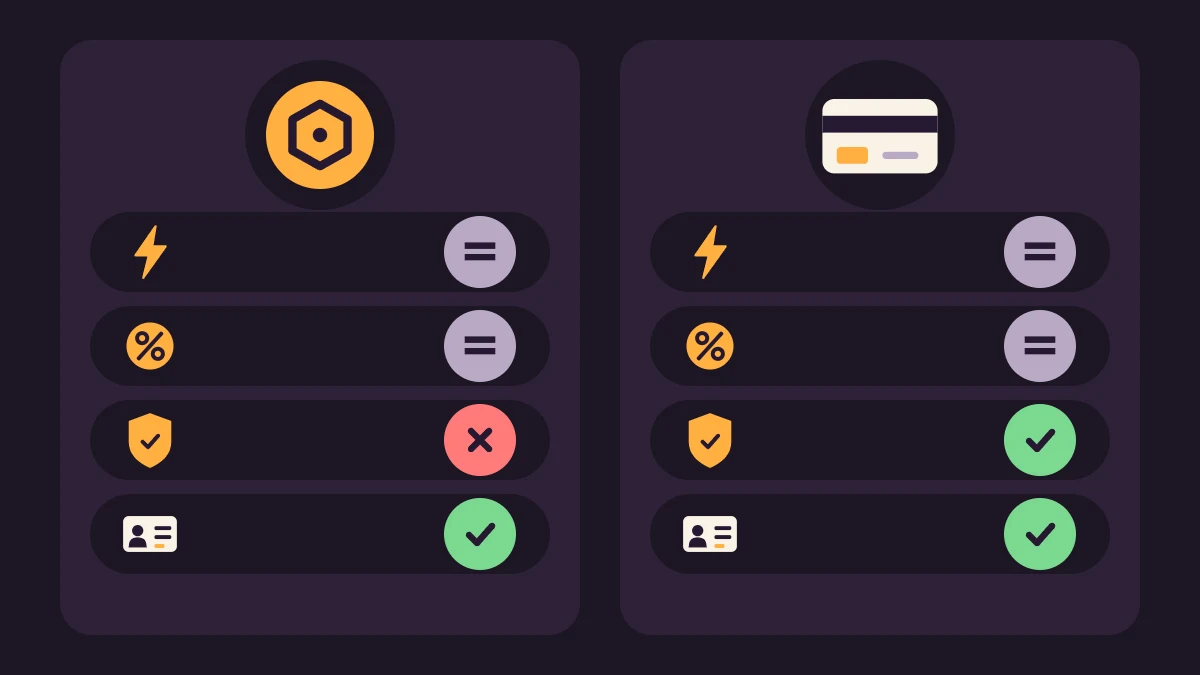
Crypto payments go straight on a blockchain. A deposit needs a number of network confirmations before the casino credits it. A withdrawal often depends on how fast the casino approves it, not on the blockchain itself. A fast coin does not mean a fast payout.
Always read the casino's own payout terms. Pending periods, limits and fees are set by the casino, whatever the payment type.
Fees, conversion and coin volatility
Fiat costs can include card fees, bank fees and currency conversion if the casino uses another currency. Crypto costs can include network fees (which change with network traffic), exchange fees when you buy or sell, and the spread between buy and sell prices.
Volatility is the big difference. A coin can change in value between the day you deposit and the day you withdraw. You can win in coin terms and still end up with less in your own currency, or the other way round. Stablecoins aim to hold a fixed value, but they carry their own risks.
- Check which currency your balance is held in.
- Check how the casino converts your deposit and your payout.
- Remember that each conversion may cost something.
Chargebacks and reversing a payment
This is where the two differ most. The US Federal Trade Commission notes that crypto payments are generally irreversible and usually lack the legal protections and dispute processes of credit or debit card payments. If you send coins to the wrong place, they come back only if the receiver chooses to return them.
Card and bank payments may offer a route to dispute a payment. This depends on your provider, your country and the circumstances. Do not count on it. Gambling payments can be treated differently, and a provider can refuse a dispute. Ask your provider what applies to you.
Identity checks still exist
Many people believe crypto means no identity checks. That is not a safe assumption. Casinos that hold a licence must follow rules to know who their customers are, and many ask for ID before a withdrawal. Some ask at sign-up, some only at a certain amount.
Plan for it. Have a clear photo of an ID and a proof of address ready. If a casino says it never checks anyone, treat that as a question mark, not a perk. See how to check if a casino is safe for why.
Records and tax
Crypto leaves a public trail on the blockchain, and exchanges keep records too. Fiat leaves bank and card statements. In both cases it helps to keep your own list of deposits, withdrawals, dates and values.
Tax rules for gambling winnings and for crypto differ by country, and they change. We give no tax advice. Check the rules where you live, or ask a qualified adviser.
Wallet and network safety
If you use crypto, a few habits matter. These points follow guidance from ethereum.org and the FTC.
- Own wallet or exchange. A wallet where you hold the keys is called self custody. An exchange holds the keys for you. Each has risks. Know which one you use.
- Never share your recovery phrase. No honest casino, support agent or website needs it.
- Check the address and the network. Sending to the wrong address, or on the wrong network, can lose the money for good. Send a small test amount first.
- Beware of fake support. Staff who message you privately and ask for approvals or keys are a known scam pattern.
- Be wary of anyone who demands crypto. The FTC warns that only scammers demand payment in crypto, so be extra careful if a stranger pushes you to pay that way.
Licence and complaints record matter more
The payment type does not tell you if a casino is fair. A site can take cards and still delay payouts. A site can take coins and still pay on time. What helps more is the licence, which you can check on the regulator's public register, the company behind the site, the terms, and the record of complaints. The UK Gambling Commission, for example, runs a public register where you can search licensed businesses. Other regulators run their own.
Our six scores, including Safety and Payouts, apply the same way to crypto and fiat. Read how we rate casinos for details.
In short
- Crypto can be faster to move, but the casino still sets payout speed.
- Crypto payments are generally not reversible. Card payments may be disputable, but not always.
- Coin prices move. Your result in your own currency can differ from your result in coin.
- ID checks usually still apply.
- Keep records and check the tax rules in your country.
- Licence, terms and complaints record matter more than how you pay.
Play with care
Gambling is for adults only (18+, or higher where your country says so). Set deposit and time limits before you start, never gamble money you need, and stop if it stops being fun. Free, confidential help exists, for example from GamCare and GambleAware in Great Britain, and from local services elsewhere. Rules differ by country, so check the law where you live before you play. Read our responsible gambling page too.