How to Check if a Casino Is Safe: A Practical Checklist
A step by step checklist to check if an online casino is safe: verify the licence on the register, read the terms, test support and spot red flags before you deposit.
By CasinoRadius team, updated 30 October 2026, 5 min read
Last checked: 29 October 2026
No checklist can make gambling risk free. But a few checks before your first deposit can help you avoid the worst problems. This guide shows what to look at, in order, and how we handle safety in our own reviews.
Licence: a claim is not a check
Almost every casino shows a licence logo in the footer. That is only a claim. A verified register entry is different: you open the regulator's own website, search for the company or licence number, and see that it is listed there.
Do this in four steps.
- Find the licence number, the licence holder's company name and the regulator in the footer or terms.
- Go to the regulator's website yourself. Do not use a link from the casino.
- Search the register for the number or company name.
- Compare: same company, same status, same website address, same licence type.
If any of these do not match, treat the claim as unproven.
Real registers and what they show
- UK Gambling Commission. Its public register lets you search licensed gambling businesses, personal licences, regulatory actions against licensees, public statements after enforcement and licensed premises. It is the clearest example of a register that also shows enforcement.
- Other regulators. Authorities in other places also issue licences, and each has its own way of listing licence holders. We could not open their registers while writing this guide, so go to the regulator's own site and look for a licensee list or a licence validator. If you cannot find one, that is worth noting.
Know that a licence from one authority does not mean the casino follows the rules of your country. Rules differ by country. Some operators are offshore and may not answer to your local regulator.
Company details
A trustworthy site names its operating company, registered address and the licence holder. Search the company name on its own with words like "complaint" or "review". Be careful if the company name is missing, if it differs between the footer and the terms, or if several sites share vague details.
Read the terms before you deposit
Open the terms and bonus terms. Look for:
- withdrawal limits, fees and pending periods
- when and what identity documents are needed
- reasons the casino can void winnings or close an account
- bonus rules, including wagering (see how to read wagering requirements)
- how complaints are handled, and which body can review them
Save a copy of the terms with the date. If terms change later, you have proof of what you agreed to.
Complaints and dispute history
Look at independent complaint sites and forums, not only the casino's own testimonials. Read several recent reports. One angry post is a data point. A pattern of unpaid withdrawals, or the same excuse repeated, is a warning.
Check if the casino works with an alternative dispute resolution (ADR) service. For example, IBAS is an ADR service that gives impartial adjudications between players and registered operators, and operators that register agree to be bound by its decisions up to a stated value. eCOGRA, a game testing lab, also lists ADR among its services. A casino that offers an independent route gives you somewhere to go if a dispute stays unsolved.
Be aware of blacklists too. We keep one, and so do other sites. A listing is a reason to read more, not a verdict on its own.
Payments and withdrawals
Before depositing, find out which methods are offered, the minimum and maximum withdrawal, the fees and the checks. Be careful if withdrawals are much harder than deposits. See crypto vs fiat casinos for how payment type changes your protection.
Test support and tools
Ask support a simple question about withdrawals before you deposit. Note how fast and how clearly they answer. Then check for responsible gambling tools: deposit limits, time limits, reality checks, cool-off and self-exclusion. A casino that hides these is a poor sign.
Red flags
- No company name or no address
- A licence claim you cannot find on the register
- Bonus terms that change after you accept
- No rules on verification, then sudden requests after you win
- Pressure to deposit now, or to deposit more to unlock a withdrawal
- Support that will not answer in writing
- Demands to pay in crypto from a stranger. The FTC lists urgency, pressure and unusual payment demands among common scam signs.
How we rate safety
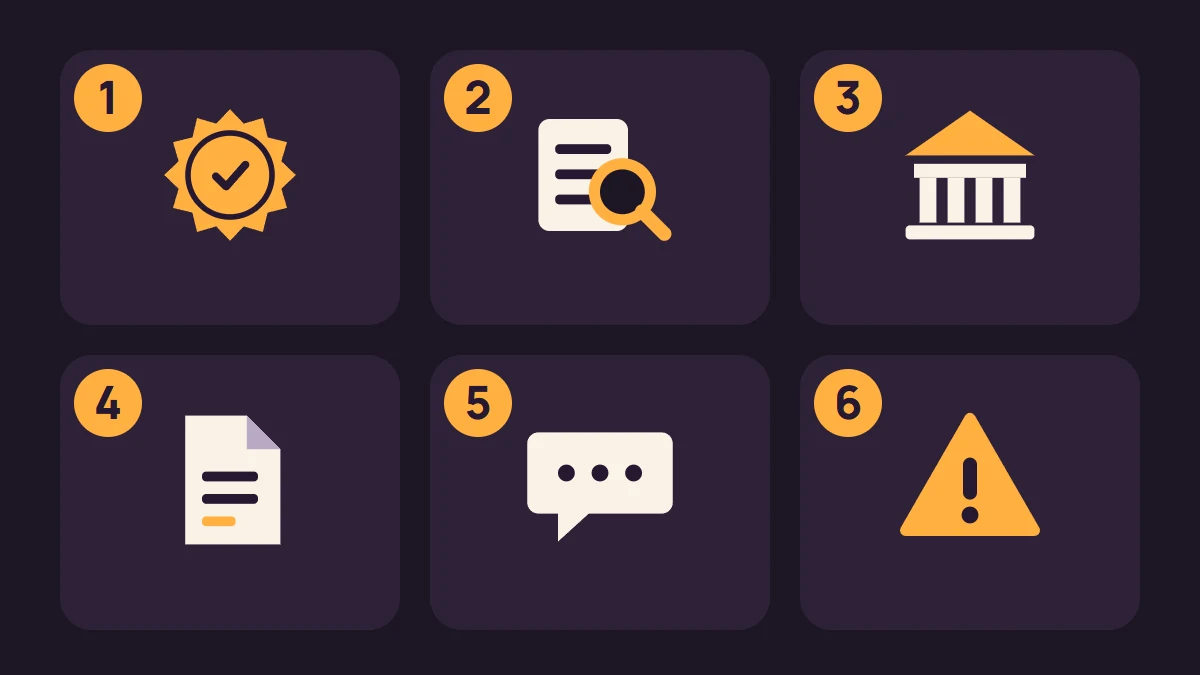
Each review on this site ends in six scores from 0 to 10. Safety is one of them and carries a 25% weight, which is the largest. Our weights are a draft and may change. Safety looks at the licence checked with the regulator, company details, data protection, account security and complaint history. Our review process includes checking the licence number with the named regulator, reading the terms and testing sign-up, support and withdrawal where it is lawful and practical. A casino cannot pay to change its scores. See how we rate casinos.
Checklist
- Licence number checked on the regulator's own register
- Company name and address match everywhere
- Terms read and saved
- Complaint history searched
- ADR route known
- Support tested
- Limits and self-exclusion tools available
- No red flags
- A deposit you can afford to lose
Play with care
Gambling is for adults only (18+, or higher where your country says so). Set limits, never chase losses and take breaks. If gambling stops being fun, help is free and confidential: for example GambleAware and GamCare in Great Britain, and local services elsewhere. Rules differ by country, so check the law where you live. See our responsible gambling page.