Bonus Buy in Slots: What It Costs and What the Risks Are
Bonus buy lets you pay a fixed price to start a slot's bonus round at once. This guide shows what that costs, why it does not make winning more likely, and what to ask before you buy.
By CasinoRadius team, updated 2 November 2026, 8 min read
Last checked: 2 November 2026
Some slots let you skip the wait. Instead of spinning until the bonus round appears, you press a button, pay a price, and the bonus starts at once. This is called bonus buy or feature buy. This guide explains what it costs, what it does not change, and why it can drain a budget fast. It is education only, not advice to use it.
What bonus buy is
A slot usually has a bonus round, for example a set of free spins. Normally it starts when special symbols land on the reels. Wikipedia notes that some bonus rounds are a special session of free spins. Landing the trigger can take many spins.
With bonus buy, you pay a fixed price to start that round directly. The price is often a multiple of your normal stake. A game might offer a price of 100 times the stake, for example. The exact multiple is shown in the game, and it differs from game to game.
The UK Gambling Commission describes the same idea as a "feature buy in" facility on slot-style games, which lets a player pay a large stake to enter the bonus feature without playing through the earlier stages.
A worked cost example
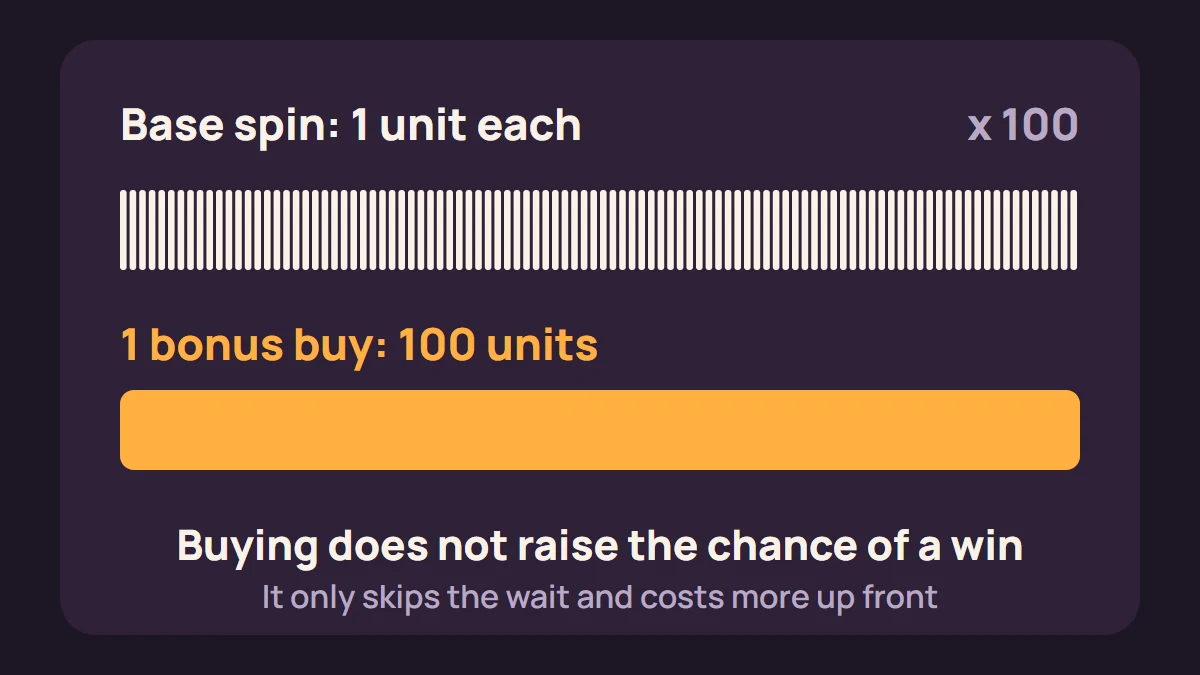
Take a simple game where the stake is 1 unit per spin and the bonus buy price is 100 times the stake.
- One purchase costs 100 units (1 x 100).
- Five purchases cost 500 units.
- Ten purchases cost 1,000 units.
Compare this with normal spins. At 1 unit a spin, 100 units pays for 100 normal spins. The same 100 units pays for just one bought bonus round.
Now the average return. Suppose the game shows an RTP of 96 percent. If the bought round has the same return, then on average 100 units staked returns 96 and the average loss is 4. For ten purchases (1,000 units staked) the average loss is 40.
That is an average over a very long run. A single bought round can pay far less than the 100 units it cost, and some pay far more. In a short run, you could buy five rounds in a row, spend 500 units and get back very little. This swing is normal for these rounds. Our guide RTP vs volatility explained shows why a long-run average says little about one session.
The numbers above are made up to show the sums. Real prices and returns are in the game's own rules.
Why it does not make winning more likely
It can feel like a shortcut to the "good part". It is not a better way to win. Here is why.
- The average return is set by the game. eCOGRA describes RTP as the percentage of wagered money a game will pay back over time, and as an average over a significant number of plays, not each play. Buying the bonus changes how fast you reach it. It does not change that the game is built to keep a share of what is staked.
- You pay for the bonus up front. The price is part of what you stake. A bonus you reach by normal spins costs you the spins on the way. A bonus you buy costs you the price. Neither is free.
- The bought round may have its own RTP. We could not confirm from a source which games do this, so do not assume the bought round returns the same as normal play. Check the game's rules or information screen for the figure that applies.
- Bonus rounds can be volatile. If a round pays little most of the time and a lot rarely, a high price means more risk per press.
Why sessions can drain a budget quickly
- Each press costs a lot. At 100 times the stake, one press is the cost of 100 normal spins.
- There is no slow build. With bonus buy, one choice can use a large part of your budget in seconds.
- Losses can push you to buy again. After a weak bought round, the urge is to buy another to "recover". That is chasing losses, and it is how budgets disappear. The UK Gambling Commission's own technical standard says products must not actively encourage customers to chase losses or raise stakes (RTS 14A, as cited in its 2020 warning).
Where it is available
Availability is not the same everywhere. It depends on the country, the licence and the casino.
- In January 2020 the UK Gambling Commission warned online operators after it found six offering feature buy-in facilities. It said this did not meet its technical standards on rules being available and accurate (RTS 3A) and on not encouraging customers to increase stakes or chase losses (RTS 14A). It also said all six operators contacted had removed the feature from their sites. One game in its example charged more than 3,000 pounds to enter the bonus feature.
- We did not confirm from a regulator's own page what the rule is in other countries, so we do not state one. Some regulators may restrict or allow it, and the rules can change. Check the regulator that licenses your casino, and the game's own information screen.
Bonus terms and bonus buy
If you have an active casino bonus, the terms may say what you may and may not do with it. As general advice, read the terms before you press anything. They may exclude certain features, limit the maximum stake while a bonus is active, or count the game differently towards wagering. We cannot say what any one set of terms says, so read yours. Our guides welcome bonus: what to check and how to read wagering requirements explain how to do this.
Questions to ask before you buy a bonus
- What is the exact price? Write it as a number of units. Is it 50 times the stake, 100 times, more?
- Can I afford the price and lose it? If losing it would hurt, do not press.
- How many presses is my whole budget? If the answer is two or three, one bad run ends the session.
- What RTP does the game show for the bought round? Is it the same as in normal play?
- What is the maximum win, and how rare is it? Rare big wins do not make the average better for you.
- Am I buying because I planned to, or because I am annoyed at a loss? If it is the second, stop.
- Do I have a bonus active? If yes, have I read what the terms say about this feature?
- Is this allowed where I live? Check the law and your regulator.
Tips for staying in control
- Set a budget first, and treat it as money spent on entertainment.
- Play only with money you can afford to lose. Never use money for rent, bills or food.
- Decide the most you will spend on bought rounds in one session, and never go over it.
- If you notice you are buying again after each loss, stop for the day.
In short
- Bonus buy is a fixed price to start a bonus round at once, often a multiple of your stake.
- The price is a real cost, and it can use up a large part of your budget with one press.
- It does not make winning more likely. The game's design sets the long-run return.
- Availability differs by country, licence and casino.
- Read the game info and the bonus terms before you press.
Play with care
Gambling is for adults aged 18 and over. It is entertainment, not a way to earn money, and it can be addictive. Play only with money you can afford to lose. Set a deposit limit and a time limit before you start, and stop when you reach them. If gambling stops being fun, talk to someone you trust. Organisations such as GambleAware offer free, confidential help (GambleAware serves people in Great Britain, so look for a service in your own country). Gambling rules and what is allowed differ by country. Check the law where you live before you play.