Types of Online Casino Games: Slots, Tables, Live, Instant
A plain guide to the main kinds of online casino games: slots, table games, live dealer and instant games. What each is, how they differ, and how to stay in control.
By CasinoRadius team, updated 30 October 2026, 7 min read
Last checked: 30 October 2026
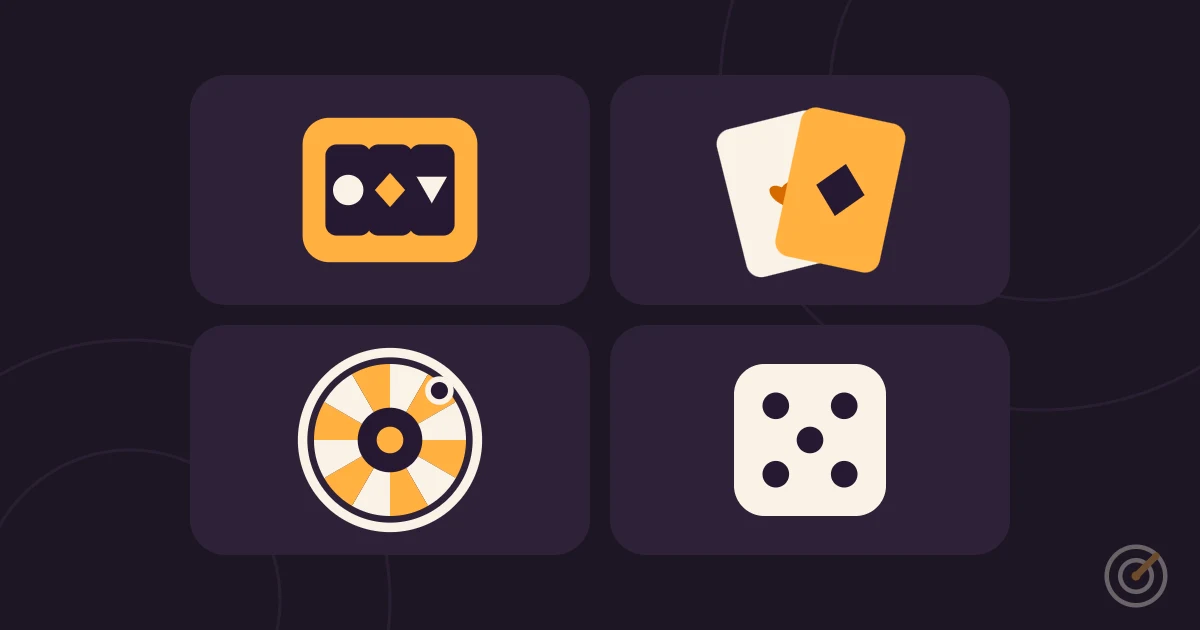
Online casinos offer hundreds of games, but most fit into four groups: slots, table games, live dealer games and instant games. This guide explains each group in plain words, so you know what you are looking at. It does not tell you what to play, and no game is a way to make money.
The four main kinds
Every game has a built-in advantage for the casino, called the house edge. Wikipedia describes it as the casino's profit as a percentage of the player's original bet. Over a long time, the casino keeps that share of all stakes. What changes between game types is the speed, the choices you make and how bumpy the results feel.
The groups also overlap. A live dealer game can be a table game, and an instant game can look like a slot. Use the groups as a rough map.
Slots
Slots are the most common online game. You set a stake and spin. Symbols land on reels, and certain combinations pay. Wikipedia notes that video slots use on-screen reels, so they can have five or more reels and many symbols.
- Paylines. These are the lines where matching symbols must land to win. Video slots can have anywhere from a few lines to over a thousand. Some games drop fixed lines and pay for matching symbols on neighbouring reels.
- RTP. The share of stakes a game is designed to return over a very long run. eCOGRA says it is an average over many plays, not a promise for one session.
- Volatility. Low volatility means smaller wins more often. High volatility means larger wins less often, with long dry spells.
- Bonus rounds. Special features, often free spins, that start when certain symbols land. They are part of the game's design and its RTP.
Results come from a random number generator, so earlier spins do not change the next one. See RTP vs volatility explained for worked examples.
Table games
Table games follow fixed rules. They are digital versions of games from a land-based casino.
- Blackjack. You try to get a hand closer to 21 than the dealer's hand without going over. You choose to take another card or stop. Rules and the number of decks change the house edge.
- Roulette. You bet on where a ball lands on a wheel with numbered pockets. Wikipedia gives the house edge as about 2.7 percent on a single-zero (European) wheel and 5.26 percent on a double-zero (American) wheel. The extra zero roughly doubles the edge.
- Baccarat. You bet on which of two hands, player or banker, will score closer to nine, or on a tie. The cards are drawn by fixed rules, so you only choose the bet.
- Poker variants. Some casino poker games are played against the house, not against other players. The rules differ by game, so read them first.
Some games let you make choices, and good choices can reduce the house edge in some of them. But no choice removes it, and no pattern or system can promise a win. Treat any "system" you read about with caution.
Live dealer games
In a live dealer game, a real person deals the cards or spins the wheel in a studio. You watch a video stream and place your bets on screen. Wikipedia explains that physical results are turned into data so the software can settle bets.
Live games cost more to run, so they usually cover popular games such as roulette, blackjack, baccarat and sic bo. Different tables often have different minimum and maximum bets, so check the limits shown at the table.
Live rounds are slower than digital ones, because the dealer has to deal and players have time to bet. The house edge still follows the rules of the game.
Instant and crash games
Instant games have very short rounds. Examples include dice games, number games and scratch-style games. Crash games show a number, called a multiplier, that rises until it suddenly stops. You choose when to cash out. If it stops before you do, you lose the stake.
Crash games feel as if skill is involved, because you choose the moment. But the stopping point is set by a random process, so you cannot read it. We did not find independent research that compares crash games with slots for risk, so we make no claim about that.
What is clear is the speed. A round can take seconds, and you can start the next one at once. More rounds per hour means more bets, and more money moving, in a short time. That makes it easy to lose track. If you try these games, set a time limit and a stake limit before you start.
Jackpots
A jackpot is a very large prize. Wikipedia explains that a progressive jackpot grows as players bet. It can be shared across linked machines, and sometimes across many casinos. A fixed jackpot stays the same size.
Jackpots are rare. A game with a big jackpot often pays smaller prizes less often elsewhere, so it can feel very high in volatility. Read the game's rules to see how the jackpot is won, and whether it needs a maximum bet. Do not let the size of a prize hide the odds.
How to choose by volatility, bet size and time
- Volatility. Low volatility gives a gentler ride. High volatility gives long dry spells. Neither one changes the long-run average.
- Bet size. Pick a stake small enough that a long losing run does not hurt. A smaller stake also makes your budget last longer.
- Time. Fast games use up money fast. Decide how long you will play, and set a timer.
- Read the rules. Check the RTP and any special rules in the game's info page.
Some sites offer demo or free play for some games. It lets you see how a game works without staking money. It can help you learn the rules and the speed. Be aware that free play can feel easier than real play, and it does not predict real results.
In short
- Slots, table games, live dealer games and instant games are the four main groups.
- Every game has a house edge, so the casino keeps a share over time.
- Results are random. Nothing is "due".
- Faster games mean more bets in less time. Set limits first.
- Rules differ by country. Check the law where you live.
Play with care
Gambling is for adults aged 18 and over. It is entertainment, not a way to earn money, and it can be addictive. Set a deposit limit and a time limit before you start, never chase losses, and stop when you reach your limits. If gambling stops being fun, talk to someone you trust. GambleAware offers free, confidential support, including blocking tools. It serves residents of Great Britain, so look for a service in your own country. Read more on our responsible gambling page.